
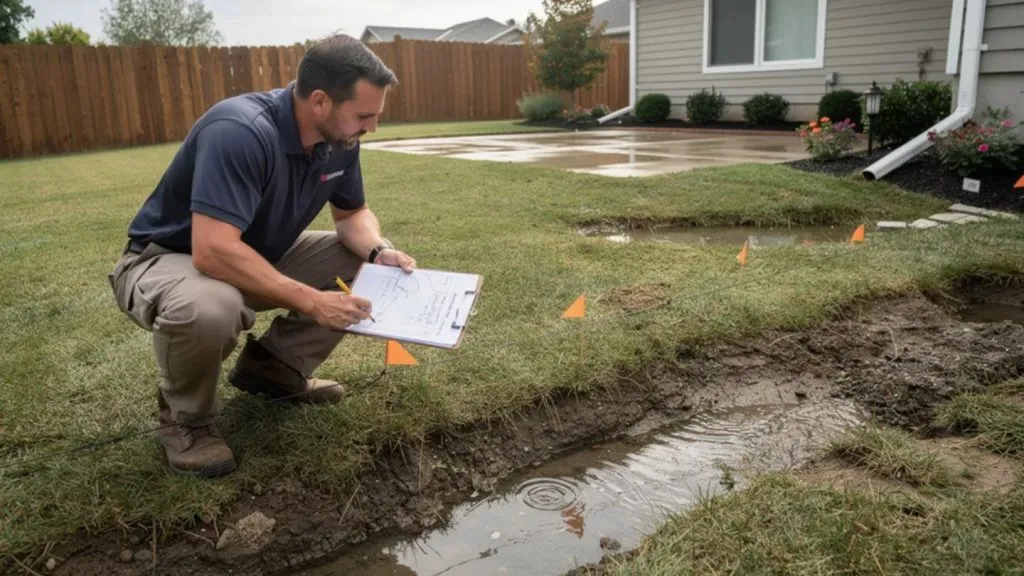
People are often surprised when I tell them that water causes more fencing problems than wind.
Storms usually get the blame because they bring fences down dramatically. You wake up, look out of the window and see panels lying across the garden. It feels like the wind did all the damage.
Most of the time, though, the fence had already been weakened by months of standing water, poor drainage or saturated ground. The storm simply finished the job.
After decades installing and repairing fences around York, I have learned that the condition of the ground is often more important than the condition of the panels themselves. A well-built fence sitting in permanently wet soil will always have a tougher life than an average fence installed in free-draining ground.
One thing I see often on local jobs is homeowners concentrating on what they can see above ground while the real problem is happening underneath. By the time someone searches for fence repairs in York, the damage has usually been developing for a long time.
Water rarely stays where you expect
Gardens are never perfectly flat, even if they appear to be.
Water always finds the lowest point.
Sometimes that’s a flower bed against the fence.
Sometimes it’s a raised border.
Sometimes it’s where an old patio settles slightly after a few winters.
The result is the same.
Moisture sits against the fence for days instead of draining away naturally.
Timber absorbs it.
Posts remain wet far longer than they should.
Concrete footings loosen as surrounding soil softens.
Eventually the fence starts moving.
I’ve visited gardens where the homeowner insisted the fence had been installed badly. Five minutes later we discovered that every downpipe on the property discharged directly beside one fence post.
No fence enjoys standing in a puddle every time it rains.
York’s clay soil creates its own challenges
Anyone who has dug fence post holes around York knows how unpredictable the ground can be.
In some areas you’ll work through decent topsoil before reaching firm subsoil.
Elsewhere you’ll hit heavy clay almost immediately.
Clay behaves differently from sandy ground.
It absorbs water.
It holds onto that water.
Then it expands.
When conditions dry out, it contracts again.
That repeated movement places constant pressure on fence posts.
From years on site, I’d say many leaning fences around York have less to do with poor workmanship than with changing ground conditions that were never properly considered during installation.
Good contractors account for this before the first post goes into the ground.
Standing water causes gradual failure
Fence failures caused by drainage rarely happen suddenly.
Instead, they develop in stages.
The post begins holding moisture.
The timber softens around ground level.
Small amounts of movement begin.
Concrete footings loosen.
Panels transfer additional strain into neighbouring posts.
Then winter arrives.
The homeowner thinks the latest storm caused the problem.
In reality, the fence had already been weakening throughout spring, summer and autumn.
This is why regular inspections matter.
Small movement is much easier to deal with than widespread collapse.
Raised flower beds often create hidden problems
Raised beds have become increasingly popular over the past few years.
They look attractive.
They’re easier to maintain.
They improve drainage for plants.
Unfortunately, they’re often built directly against existing fencing.
That creates one of the most common repair issues I encounter.
The fence effectively becomes a retaining wall.
It wasn’t designed for that job.
The additional weight from wet soil pushes constantly against the panels.
Moisture remains trapped around the posts.
Airflow disappears.
Timber never fully dries.
I’ve removed plenty of fence panels that looked perfectly healthy from one side while the rear face had already started rotting because it remained permanently buried behind raised borders.
If you’re planning raised beds, leave a small gap between the soil and the fencing wherever possible.
Your fence will last much longer.
Gravel boards do more than people realise
Some homeowners see gravel boards as an optional extra.
I’d disagree.
Gravel boards provide an important barrier between the panels and damp ground.
Instead of moisture soaking directly into the bottom rail, the gravel board takes most of the punishment.
Timber gravel boards eventually wear out.
That’s perfectly normal.
Replacing one gravel board every so often is considerably cheaper than replacing every panel above it.
Concrete gravel boards offer even greater longevity, although they aren’t suitable for every garden.
Choosing the right option depends on the overall design and the conditions on site.
Gutters can damage fencing too
Not every drainage issue begins in the garden.
Sometimes it starts much higher.
Overflowing gutters.
Blocked downpipes.
Broken gutter joints.
Leaking drains.
All of these can direct huge amounts of water towards boundary fencing.
I’ve attended repair jobs where the fence itself was perfectly adequate.
The real issue turned out to be a blocked gutter overflowing every time it rained.
The same fence post received hundreds of litres of water week after week.
Eventually the timber gave up.
Fixing the fence without solving the drainage would simply have repeated the cycle.
Trees can make drainage unpredictable
Tree roots complicate fencing in several ways.
Large roots prevent proper post positioning.
They also absorb enormous quantities of water during dry weather.
When rainfall returns, surrounding ground moisture changes again.
Some trees encourage localised drying.
Others create shaded areas where moisture lingers.
Neither situation is automatically good or bad.
It simply means experienced fencing contractors adapt their installation methods to suit the conditions rather than following exactly the same approach on every property.
That’s one reason identical fences can perform completely differently just a few streets apart.
The cheapest repair isn’t always the best repair
People understandably want repairs kept affordable.
There’s nothing wrong with that.
The mistake is focusing purely on replacing whatever has visibly failed.
If a rotten post is caused by standing water, installing another post in exactly the same conditions won’t solve anything.
Good repairs investigate why the failure happened.
Perhaps drainage needs improving.
Perhaps the surrounding soil needs lowering slightly.
Perhaps a leaking downpipe requires attention.
Perhaps the raised border needs altering.
Addressing the underlying cause usually provides far better value than repeatedly replacing the same components every few years.
Composite fencing still needs good drainage
Composite fencing continues growing in popularity.
Less maintenance appeals to many homeowners.
The boards themselves resist moisture much better than timber.
The supporting structure still matters though.
Composite systems rely on solid foundations.
Weak posts remain weak posts.
Poor drainage still softens surrounding ground.
Water still affects concrete.
I’ve seen composite installations begin leaning because the post foundations beneath them weren’t suited to the conditions.
Modern materials cannot compensate for poor groundwork.
Autumn is the best time to inspect
Autumn offers a useful opportunity before winter weather really takes hold.
Walk around the garden after heavy rain.
See where water collects.
Notice whether any fence posts remain damp long after everything else has dried.
Check for movement by gently pushing each post.
Look underneath gravel boards.
Inspect gates for early signs of dropping.
These simple observations reveal far more than inspecting fencing during dry weather.
Water shows you exactly where future problems are likely to develop.
Small warning signs shouldn’t be ignored
There are several indicators that drainage may already be affecting your fencing.
Watch for:
- Posts that feel slightly loose.
- Dark staining around ground level.
- Moss building up on lower timber.
- Gravel boards disappearing beneath soil.
- Persistent puddles after rainfall.
- Gates becoming difficult to close.
- Panels gradually moving out of line.
- Concrete lifting around post bases.
None of these automatically means replacement is required.
They simply deserve attention before another wet winter makes them worse.
Better drainage doesn’t always mean major work
People sometimes imagine drainage improvements involve expensive landscaping.
Often they don’t.
Clearing blocked gullies.
Lowering soil levels slightly.
Creating a small drainage channel.
Moving stored materials away from the fence.
Redirecting a downpipe.
Removing built-up leaves.
Trimming vegetation to improve airflow.
Simple changes can dramatically reduce moisture around fence posts.
Sometimes that’s enough to add years to an existing installation.
Installation still matters
Good drainage won’t rescue poor workmanship.
Likewise, excellent workmanship struggles against permanently waterlogged ground.
Both need to work together.
Proper post depth.
Suitable concrete.
Correct spacing.
Appropriate gravel boards.
Thoughtful drainage.
Reasonable maintenance.
None of these individually guarantees a long-lasting fence.
Combined, they make an enormous difference.
That’s why experienced fencing contractors spend so much time looking at the ground before discussing panels.
The foundation of every successful fence starts well below the surface.
Choosing a contractor who looks beyond the fence
Whether you’re searching for fencing companies near me or asking neighbours for recommendations, pay attention to the questions you’re asked during the survey.
A good fencing contractor will usually want to know:
Where does water collect?
Has the fence moved gradually?
Have any posts already been replaced?
Do gutters overflow nearby?
Has the garden been raised recently?
Are there tree roots below ground?
Those questions tell you something important.
They’re looking for causes rather than symptoms.
That’s often the difference between a repair that lasts a decade and one that lasts until the next wet winter.
The ground decides more than the panels
People naturally focus on the visible parts of a fence.
That’s understandable.
Panels define the appearance of a garden.
Posts, concrete and drainage rarely get much attention until something goes wrong.
Yet those hidden details decide how well the entire boundary performs.
A strong-looking fence installed into poor drainage will eventually struggle.
A modest timber fence with good foundations and sensible water management can remain standing for decades.
The next time heavy rain settles across your garden, don’t just look at the fence.
Watch where the water goes.
It will often tell you exactly where the next repair is waiting to happen.


More Stories
Office Interior Designer in Noida for Modern & Functional Offices